
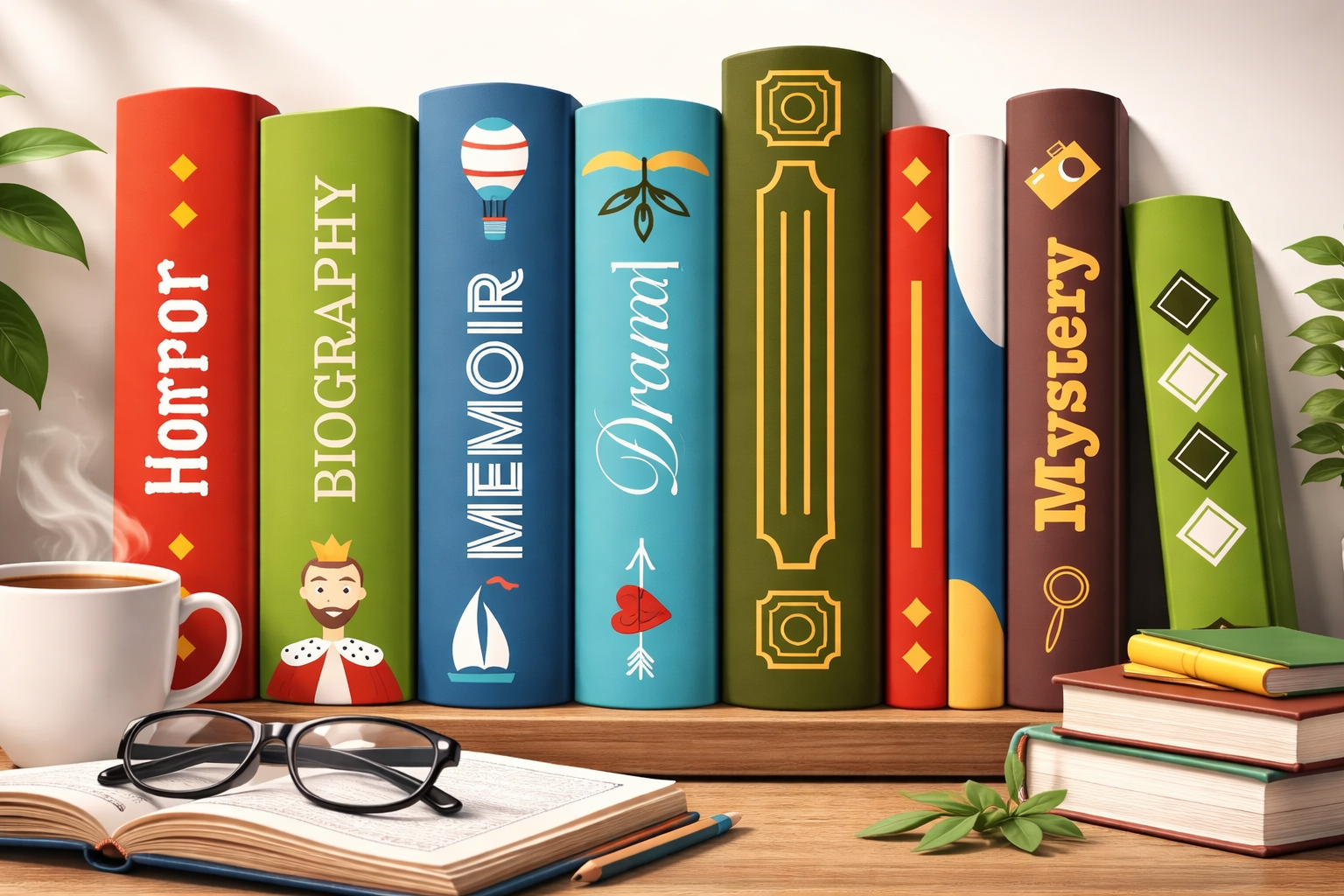
Walk into any bookshop and the first thing you notice is how the shelves are sorted. Romance here. Crime over there. Biography down the back. That sorting system, the one that quietly guides you toward the kind of story you’re in the mood for, is genre doing its job.
But book genres are more than just a convenience for booksellers. They’re a language. When a reader picks up a thriller, they’ve already made a deal with the story before they’ve read a single word. They’re expecting tension, pacing, stakes. When someone grabs a memoir off the shelf, they’re coming to it differently, ready to sit inside someone else’s lived experience. Genre sets that expectation, and when a book delivers on it, something clicks.
For publishers, that click matters enormously. At Sydney Book Publishers, the question of genre isn’t just a cataloguing exercise. It shapes everything from how a manuscript is developed to how it’s marketed, who it’s pitched to, and how it finds its way into the hands of the people most likely to love it. Genre is the connective tissue between the book and its reader.
The concept itself is older than modern publishing. Literary scholars trace genre categories back to ancient Greece, where poetry, drama, and rhetoric each had their own rules and expectations. What counts as a genre today, though, has evolved significantly. New categories emerge, old ones splinter into subgenres, and the lines between them blur and shift as reading habits change.
So what actually defines a book genre? In the simplest terms, a genre is a category that groups books by their shared characteristics, whether that’s subject matter, narrative structure, tone, setting, or the kind of experience they’re designed to give the reader. It’s not a rigid box so much as a shorthand, a way of quickly communicating the territory a book is working in.
Understanding genres also has a direct impact on how books sell. Readers who love science fiction know which shelves to haunt, which authors to follow, and which cover designs signal “this is for you.” That kind of genre literacy is something Sydney Book Publishers takes seriously, because reaching the right reader isn’t luck. It’s knowing exactly what different book genres mean, who reads them, and why.
There’s no universally agreed-upon number of book genres. Depending on who you ask, the answer might range from a dozen to several hundred, especially once subgenres come into the picture. But for the purposes of this guide, we’re looking at the thirty-five genres that matter most in today’s publishing landscape, the ones you’ll encounter on bestseller lists, in literary journals, and across the catalogues of publishers like Sydney Book Publishers.
These span both the world of fiction genres and non-fiction categories, and each one has its own distinct character, readership, and set of conventions.
Fantasy is one of the most expansive genres in all of literature. It includes everything from the high fantasy epics of Tolkien to the urban fantasy of Neil Gaiman, the grimdark grit of Joe Abercrombie, and the cosy fantasy that’s taken the reading world by storm in recent years. What ties them together is the presence of a world where the rules of reality don’t apply in the same way. Magic exists. Different beings walk the earth. The impossible happens. Fantasy gives writers extraordinary freedom and gives readers the chance to completely step outside the world as it is.
Romance is the highest-selling fiction genre globally and has been for decades. It’s also one of the most misunderstood. Romance novels aren’t simply “love stories.” They’re a genre with clear structural conventions, most notably the HEA (Happily Ever After) or HFN (Happy For Now) ending. Within those conventions, the range is massive. Historical romance, paranormal romance, contemporary romance, romantic suspense, sports romance, and dark romance are just a handful of the thriving subgenres underneath the main category. A Court of Thorns and Roses by Sarah J. Maas is a good example of how fantasy and romance collide into something that becomes its own phenomenon.
Science fiction is a genre built on ideas. It takes the technology, politics, and anxieties of the present and extends them into speculative futures or alternate realities. Space opera like Dune operates on an epic scale. Cyberpunk, think Philip K. Dick or William Gibson, focuses on technology’s effect on identity and society. Hard science fiction leans into scientific accuracy and rigor. Soft science fiction is more interested in social dynamics than physics. The definition of science fiction shifts constantly, expanding to include climate fiction, biopunk, solarpunk, and more.
Mystery is one of the oldest and most enduring fiction genre types, rooted in the work of writers like Arthur Conan Doyle and Agatha Christie. At its core, a mystery presents a problem, usually a crime, and tasks the reader with piecing together the solution alongside the protagonist. Subgenres include cosy mysteries (light-hearted, often humorous), hardboiled detective fiction (gritty, morally complex), and police procedurals that focus on investigative process.
Thriller and suspense are the genres that keep you turning pages at 2am. Where mystery focuses on solving something that’s already happened, thrillers operate in the present tense of danger. The threat is ongoing. The stakes are high. The clock is ticking. This genre encompasses psychological thrillers, political thrillers, legal thrillers, and action thrillers, each with its own flavour of tension.
Horror as a genre is dedicated to one primary purpose: making the reader feel afraid. But genuine horror is about much more than jump scares or gore. The best horror uses supernatural or extreme scenarios to explore real human fears, death, loss of control, the unknown, the corrupted familiar. Stephen King is the obvious entry point, but horror literature spans everything from Gothic fiction to folk horror, creature horror, and quiet literary horror.
Historical fiction brings the past to life through narrative. It’s not history textbooks, it’s the lived texture of another era, rendered through characters, dialogue, and sensory detail. The research burden is significant, but when done well, historical fiction delivers an immersive experience that no documentary can match.
Literary fiction is less about plot and more about language, character, and ideas. It’s the genre most associated with literary prizes and critical acclaim. It tends to resist easy categorisation and often defies conventional narrative structure. Authors like Hilary Mantel, Kazuo Ishiguro, and Sally Rooney work in this space.
Adventure fiction is driven by physical action, exploration, and external conflict. It’s the genre of Jules Verne, H. Rider Haggard, and more recently, authors like Matthew Reilly. The focus is on excitement and movement through the world.
Graphic novels and comics exist as their own distinct category, combining visual art and narrative in ways that neither prose nor film can quite replicate. They span every other genre, from superhero fantasy to memoir to horror.
Children’s fiction encompasses picture books, middle grade, and everything in between. It’s a genre defined by its audience rather than its content, though it tends toward wonder, discovery, and resilience as recurring themes.
Young Adult, or YA, targets readers roughly between the ages of twelve and eighteen, though adult readers consume it in huge numbers. YA often explores identity, belonging, first loves, and the negotiation between personal values and the world.
New Adult is a relatively recent category that bridges YA and adult fiction, typically featuring protagonists in their late teens to mid-twenties navigating university, early careers, and adult relationships.
Paranormal fiction incorporates supernatural elements, ghosts, vampires, witches, werewolves, within a contemporary or near-contemporary setting. It’s closely related to fantasy but tends to feel more grounded in the recognisable world.
Western fiction is set in the American frontier and explores themes of law, justice, survival, and the mythology of the cowland. It’s less dominant commercially than it once was but still has a dedicated readership and has experienced something of a literary revival.
Dystopian and post-apocalyptic fiction imagines worlds that have gone wrong in specific ways, through totalitarianism, environmental collapse, technological overreach, or social fracture. The Handmaid’s Tale, 1984, and The Road are landmarks of the genre.
Magical realism is a genre where magical elements exist as a normal part of an otherwise realistic world. Associated strongly with Latin American literature, particularly the work of Gabriel García Márquez, it’s also flourished across African, Asian, and European literary traditions.
Folklore and mythology as a genre draws directly from oral traditions, fairy tales, and ancient stories, retelling or reimagining them through a contemporary lens. Folklore examples in modern fiction include works like Circe by Madeline Miller, which brings Greek mythology into vivid, human focus.
Biography tells the story of a real person’s life, written by someone else. Authorised biographies work with the subject’s cooperation. Unauthorised biographies are researched independently. Great biography reads like great narrative fiction, except the stakes are real.
Memoir is the genre where the author writes about their own experiences. Unlike autobiography, which tends toward comprehensiveness, memoir usually focuses on a specific period or theme. It’s a genre that rewards vulnerability and specificity. Wild by Cheryl Strayed and When Breath Becomes Air by Paul Kalanithi are contemporary examples that have reached enormous audiences.
Self-help and personal growth is the genre built around practical improvement. Whether it’s productivity, relationships, mindset, finance, or health, self-help books offer frameworks and tools readers can apply directly to their own lives. It’s consistently one of the highest-selling non-fiction categories.
History as a genre includes both popular history aimed at general readers and more academic works. The best popular history reads almost like fiction, using narrative techniques to bring historical events and figures to life. Sapiens by Yuval Noah Harari is a recent example that found a mainstream audience far beyond history enthusiasts.
True crime has exploded in popularity over the past decade, partly driven by the success of true crime podcasts and documentary series. Books in this genre investigate real crimes, often focusing on the psychology of perpetrators, the failures of institutions, or the experience of victims and survivors.
Religion and spirituality covers an enormous range, from theological scholarship to practical guides to devotional writing to explorations of different faith traditions. It remains one of the consistently best-selling non-fiction categories globally.
Science and nature writing brings the natural world and scientific inquiry into accessible, engaging prose. Authors like Oliver Sacks, Richard Feynman, and more recently Elizabeth Kolbert have shown how richly this genre can reward curious readers.
Travel writing turns physical journeys into literary ones. At its best, it’s both adventure and meditation, using place as a lens for examining culture, history, and the self.
Food and cookery sits at the intersection of practical instruction and cultural storytelling. Cookbooks range from purely functional to deeply personal, and the genre has expanded significantly to include essays, narrative non-fiction, and cultural history alongside recipes.
Politics and current affairs covers commentary, analysis, and journalism about the world as it is today and the forces shaping it. It’s a genre that ages quickly but at its best captures a moment in ways that remain relevant long after the immediate news cycle has moved on.
Philosophy and essays is a genre rooted in ideas, argument, and the act of thinking on the page. From Montaigne to contemporary essayists like David Foster Wallace, this is a genre that rewards slow, attentive reading.
Business and economics includes everything from startup culture to macroeconomic theory to management thinking. It’s one of the most commercially active non-fiction categories, driven by a readership always looking for an edge or a new framework.
Health, wellness, and fitness covers both practical guides and deeper explorations of how we inhabit our bodies and minds. It’s a category that overlaps significantly with self-help and science writing.
Education and academic writing covers textbooks, research publications, and works intended to teach or challenge within specific disciplines.
Humour and comedy as a non-fiction genre encompasses everything from personal essay collections to absurdist observation. It’s a genre that looks easy and is genuinely difficult to do well.
If you’re expecting a clean answer to this, publishing is about to disappoint you. The number of recognised genres varies significantly depending on who’s doing the counting and what system they’re using. The Library of Congress uses a different classification structure to the Dewey Decimal System, which differs again from how Amazon categorises books for its own retail purposes, which is different again from how literary critics and academics think about genre.
The broad consensus in the publishing industry recognises somewhere between twelve and twenty major genre categories, each of which branches into numerous subgenres. If you count all those subgenres, you can push the number well above two hundred without too much difficulty.
What makes this question more interesting than it might seem is the way genres emerge, stabilise, and sometimes disappear. Climate fiction (cli-fi) didn’t exist as a recognised category a few decades ago. New Adult is only about fifteen years old as a distinct label. Genre is a living system, not a fixed taxonomy, and it shifts in response to what writers are creating and what readers are demanding.
Traditional classification systems, the kind used by libraries, tend to divide things broadly into fiction and non-fiction, then into major genre categories like literary fiction, genre fiction, biography, history, and so on. Booksellers and publishers often work with more granular categories because specificity helps with marketing and discoverability. A book described as “fiction” tells you almost nothing. A book described as “dark romantic fantasy” tells you a great deal.
The lesson for authors and readers alike is that genre categories are useful tools, not rigid rules. Understanding the full range of book types available, from the major categories down to the niche subgenres, is genuinely valuable for anyone serious about either reading or writing.
Fiction genre types can be broadly sorted into two camps: genre fiction and literary fiction. Genre fiction follows established conventions that readers recognise and expect. Literary fiction is more focused on style, language, and ideas, often resisting those conventions deliberately. In practice, the best fiction often operates across both categories simultaneously.
Fantasy has evolved into one of the most expansive and commercially powerful genres in publishing. Epic or high fantasy, the kind that dominated the field in the second half of the twentieth century, involves world-building on a grand scale, complete with invented languages, detailed maps, complex political systems, and multi-book narratives. But the genre has diversified dramatically. Grimdark fantasy, associated with authors like Joe Abercrombie and George R.R. Martin, emphasises moral ambiguity and harsh consequences. Urban fantasy, like the Dresden Files or Neverwhere, sets magic and supernatural elements within contemporary cities. Cosy fantasy, the genre’s most recent and fastest-growing subgenre, brings warmth, community, and lower stakes to a genre that had long trended toward darkness.
Science fiction remains one of the most intellectually ambitious of all the fiction genre types. Hard science fiction writers like Kim Stanley Robinson and Andy Weir ground their narratives in scientific plausibility. Space opera on the scale of Frank Herbert’s Dune or Iain M. Banks’ Culture novels operates at a civilisational scale. Cyberpunk, one of the most culturally influential science fiction subgenres, anticipated much of the digital world we now inhabit. The definition of science fiction continues to expand: cli-fi addresses climate change; biopunk explores genetic engineering; hopepunk pushes back against despair with deliberate optimism.
Mystery and thriller are sometimes treated as a single category, but they’re distinct in meaningful ways. Mystery focuses on the intellectual puzzle of what happened and who did it. The pleasure is in the deduction, the clue-hunting, the revelation. Thriller focuses on ongoing danger, the emotional experience of being in the middle of something dangerous and working to survive or succeed. The genres overlap regularly, in the psychological thriller, the crime thriller, the domestic suspense novel, but they each serve a slightly different reader need.
Romance is the genre most defined by reader expectation. The central love story and the emotionally satisfying ending are not optional, they’re the genre’s defining contract with its readers. But within that contract, the range of subgenres is extraordinary. Historical romance, often set in Regency or Victorian England, is perennially popular. Paranormal romance, which might involve vampires, shifters, or fae, has a massive and devoted readership. Dark romance explores morally complex or transgressive relationship dynamics. Sports romance has surged in recent years, as have romantasy (romantic fantasy) and BookTok-driven subgenres that don’t always have established names yet. The global appeal of romance fiction is unmatched by any other fiction genre.
Non-fiction is a vast and often underestimated category. Readers who describe themselves as “not reading non-fiction” often simply haven’t found the right entry point, because the genres of nonfiction are as varied as those of fiction.
Biography and memoir are the non-fiction genres closest to fiction in their narrative structure. Great biography and memoir read like novels. They have character development, rising action, emotional climax, and resolution. What they also have is truth, which gives them a different kind of weight. Memoir in particular has seen a significant surge in both quality and readership over the past two decades, driven partly by writers like Mary Karr, Maggie Nelson, and Roxane Gay who have expanded what the genre can do formally and thematically. The importance of personal stories in this genre is that they don’t just reflect one life, they illuminate something universal. Readers connect with memoir because it gives them access to an experience they haven’t lived, and often find themselves inside it.
Self-help and personal growth is a genre that attracts a great deal of scepticism from certain quarters of the literary establishment, and a great deal of genuine engagement from millions of readers. It’s also one of the non-fiction genres with the most direct relationship to its reader’s life. A memoir might change how you see the world. A self-help book, at its best, changes what you do on a Tuesday morning. The rise of motivational and educational books in this space reflects a genuine appetite for frameworks, tools, and perspectives that make daily life more manageable, more productive, or more meaningful. Authors like James Clear (Atomic Habits), Brené Brown, and Malcolm Gladwell have all, in different ways, shown how ideas-led non-fiction can reach enormous audiences when it connects with real human concerns.
True crime is arguably the most culturally dominant non-fiction genre of the past decade. What began as a relatively niche category, with writers like Ann Rule and Truman Capote’s In Cold Blood as its touchstones, has expanded into one of the most active and diverse areas of publishing. The reasons readers are drawn to true crime are complex and often debated, curiosity about human darkness, the search for justice, fascination with investigation, and the desire to understand behaviour that defies easy comprehension. Books like I’ll Be Gone in the Dark by Michelle McNamara and Say Nothing by Patrick Radden Keefe have demonstrated that true crime can function as serious literary non-fiction, combining meticulous research with compelling narrative craft.
Reading habits shift constantly, and what dominates the market in any given year reflects a combination of cultural mood, social media influence, and the kind of books that publishers are commissioning. That said, some patterns are consistent enough to be worth noting.
Romance has held the top spot in fiction sales globally for years and shows no signs of relinquishing it. Its dominance accelerated significantly with the rise of BookTok, the reading community on TikTok that has proven extraordinarily powerful at driving sales of specific titles and subgenres. Romantasy in particular, blending romance and fantasy elements, has been one of the fastest-growing categories of the mid-2020s.
Thriller and crime fiction consistently occupies multiple spots in the weekly bestseller lists. Richard Osman’s Thursday Murder Club series in the UK is a recent example of how the mystery genre, when it finds the right voice and the right hook, can crossover into mainstream cultural events.
Fantasy has experienced a significant commercial boom, partly through the “slow burn” phenomenon, where long-standing series find new readers via streaming adaptations or social media communities. Literary fiction continues to generate significant critical attention, particularly around prize season.
In non-fiction, self-help and personal development remains the highest-selling non-fiction category globally. Cookery and food books are perennially strong performers. True crime continues its sustained commercial run. And in recent years, books exploring race, identity, social justice, and mental health have become a significant and commercially important category in their own right.
The fastest-growing book genre by most measures is romantasy, followed closely by the broader category of “dark romance,” both of which have been turbocharged by social media readership communities that bypass traditional marketing entirely.
Not every book fits neatly into a single box. Genre-blending, sometimes called cross-genre writing, is the practice of combining elements from two or more genres to create something that doesn’t quite fit the existing categories.
Romantic suspense, for instance, combines the structural conventions of romance (a central love story, an emotionally satisfying resolution) with the tension and danger of a thriller. Science fiction fantasy blends speculative worldbuilding with magic systems, drawing from both traditions without belonging entirely to either. Historical mystery takes the puzzle-solving framework of the mystery genre and sets it in the past, using historical detail as both atmosphere and plot element.
Genre-blending has always existed in literature, but it’s become more explicitly acknowledged and even celebrated in contemporary publishing. Readers who describe themselves as fans of “romantasy” or “dark academia” are essentially asking for specific combinations of genre elements, not a single genre.
At Sydney Book Publishers, this is a development we find genuinely exciting. Books that live at the intersection of categories often reach readers who might not have found them through a single genre label. They require a bit more thought in terms of positioning and marketing, but the reward is a book that can speak to multiple communities simultaneously.
The key for authors exploring genre-blending is to understand the conventions you’re borrowing from before you start combining them. The most successful cross-genre books aren’t random mashups, they’re deliberate, informed compositions that know exactly which expectations they’re meeting and which ones they’re subverting.
Genre isn’t just a reader’s convenience. In publishing, it has direct and practical consequences at every stage of the process.
From a commissioning perspective, genre determines which editors a manuscript is pitched to, what comparable titles are cited in a proposal, and what the commercial expectations for the book look like. A debut thriller carries different sales projections to a debut literary novel, and both carry different projections to a first-time children’s book.
For marketing and cover design, genre signals are communicated visually before a single word is read. Cover fonts, colour palettes, image choices, and layout conventions are all heavily genre-specific. A fantasy novel with a thriller cover is going to find the wrong readers, and those readers are going to leave disappointed reviews. Getting the genre right in the visual presentation is just as important as getting it right in the content.
Distribution channels and retailer categories are also shaped by genre. How a book is classified determines where it sits in an online retailer’s algorithm, which browsing categories it appears in, and which recommendation systems pick it up. In an increasingly algorithm-driven retail environment, accurate genre classification is directly linked to discoverability.
At Sydney Book Publishers, understanding the landscape of book genres, and staying current with how those genres are shifting, is core to how we work with authors. It’s not about forcing manuscripts into boxes. It’s about understanding what readers in a given genre are looking for and helping authors reach them.
Sydney Book Publishers works across a wide range of genres, both in fiction and non-fiction, with a particular emphasis on quality of craft and clarity of voice.
In fiction, the genres we work most actively within include fantasy (across its major subgenres, from epic to urban to romantasy), romance in its various forms, thriller and crime fiction, literary fiction, and historical fiction. We’re also actively engaged with the emerging cross-genre categories that are capturing significant reader attention.
In non-fiction, our focus areas include memoir and biography, self-help and personal development, history, true crime, and narrative non-fiction that blends journalistic rigour with literary craft.
What distinguishes our approach is that we look beyond genre as a simple category. We’re interested in how a book uses the conventions of its genre, what it adds to them, where it pushes against them. The most memorable books, regardless of which section of the bookshop they sit in, tend to be the ones that do something specific and alive within their genre rather than simply replicating what’s already there.
We’re also committed to recognising and developing subgenres and emerging categories that the broader market is beginning to take notice of, because the history of publishing is full of examples of editors who found a devoted readership by understanding what was coming before it arrived.
Understanding the genre you’re writing in is the starting point, but executing it well requires something more specific. Different genres have different craft demands, and the best advice for any author is genre-specific.
Fantasy requires world-building, but world-building is a means to an end, not an end in itself. The trap many beginning fantasy writers fall into is spending so much energy on the world that the story and characters get left behind. Your world needs to feel alive and internally consistent, but the reader needs to care about the people in it. Character first, world second.
Romance demands emotional authenticity above almost everything else. Readers of romance novels are sophisticated consumers who can identify the difference between genuine emotional tension and manufactured drama. The chemistry between protagonists needs to feel real, the obstacles to the relationship need to feel meaningful, and the resolution needs to feel earned. Tropes are not the enemy in romance, but executing them with freshness and emotional honesty is the challenge.
Thriller writing is fundamentally about pacing. Every chapter needs to move, every scene needs to raise the stakes or reveal something that changes the equation. The first-time thriller writer’s most common mistake is spending too long setting up before the real tension begins. Readers of this genre want to be in the middle of something dangerous from early on.
Mystery requires an entirely different kind of structural thinking. You’re building a puzzle, which means you need to know the solution before you know the narrative. Working backwards from the reveal is a common and effective approach. Clues need to be planted fairly but not obviously, and the solution needs to be something the reader could theoretically have worked out, even if they didn’t.
Memoir demands the opposite of the impulse to make yourself look good. The best memoir writers are unflinchingly honest about their own failures, confusions, and contradictions. The voice needs to be specific and genuine. Write the version of events that’s true, not the version that’s flattering.
Self-help writing lives or dies on the quality of the underlying insight and the clarity of its presentation. Readers come to this genre with a specific problem they want help with. Don’t bury the practical wisdom under excessive anecdote or theoretical framework. Be useful, be specific, and be honest about what you know and what you don’t.
Genre flexibility is a genuine advantage for writers, but it comes with real considerations. The most obvious benefit is creative range. An author who can write across genres isn’t limited by the commercial fortunes of a single category or constrained by the conventions of one type of storytelling.
There’s also the commercial argument. Some genres have shorter commercial cycles or more volatile sales patterns than others. An author with books in multiple categories has a more diversified income stream. And genre-blending, as we’ve discussed, can open up reader communities that a single-genre writer simply won’t access.
The challenge is that different genres often require different reader relationships. Romance readers build devoted loyalty to authors whose books they trust to deliver a specific emotional experience. If that author suddenly publishes a dark literary novel, some of those readers will feel confused or even let down. Many authors who write across genres use pen names for exactly this reason, to manage reader expectations clearly and maintain distinct brand identities for different types of work.
The advice from a publishing perspective is to understand your audience for each genre you write in, treat each one seriously on its own terms, and think carefully about how you present yourself as an author across different categories.
Working with Sydney Book Publishers means working with a team that understands the nuances of genre not just in theory but in practice. We know what fantasy readers expect from a cover and what they’ll forgive in a plot. We know the structural requirements of a good thriller and the emotional architecture of a satisfying romance. We know what makes a memoir resonate and what makes one fall flat.
Choosing to work with a publisher who understands your genre deeply means you’re not explaining the basics from scratch. You’re working with people who can have a meaningful conversation about where your book sits within its category, what it’s doing that’s been done before, and what it’s doing that’s genuinely new.
Our expertise across the full range of book genres, from fiction to non-fiction, from established categories to emerging subgenres, means we can offer authors informed guidance at every stage, from manuscript development through to marketing and distribution.
The goal, always, is to match the right book with the right reader. Genre is how we do that.
Genre is not static. It never has been. The categories that feel completely natural to us today, the thriller, the fantasy novel, the self-help book, are all historically recent constructions. And the categories that will feel natural to readers in twenty years are, in some cases, only beginning to take shape right now.
A few trends are worth watching. The ongoing influence of social media on reading culture, particularly TikTok’s BookTok community, is creating genre movements that happen outside of traditional publishing channels. Categories like “romantasy” or “dark academia” became commercially significant before most publishers had fully processed what was happening. The publishers and authors who pay attention to where reader communities are forming are going to be better positioned to understand what comes next.
Digital literature and interactive storytelling are genuinely expanding what “a book” can be. Serialised fiction through platforms like Kindle Vella, Webtoon, or Royal Road has produced huge readerships in genres that don’t always translate into traditional print publishing, with litRPG and progression fantasy as obvious examples. Whether these become fully mainstream categories or remain distinct digital subcultures remains to be seen.
The blurring of genre lines is likely to continue. As readers become more genre-literate and more open to books that don’t fit neatly into a single category, publishers will continue to develop the vocabulary and the infrastructure to support cross-genre and hybrid works.
What won’t change is the fundamental purpose of genre. It will still be the way readers and writers find each other. The labels may shift, new categories will emerge, and old ones will evolve, but the underlying function, connecting a book to the people most likely to love it, will remain exactly what it’s always been.
If you’re an author working in any of the genres we’ve explored here, whether you’re deep in a fantasy manuscript, finishing a memoir, or figuring out where your genre-blending project actually belongs, we’d love to hear from you.
Sydney Book Publishers works with authors at every stage of their journey. From developing a manuscript through to getting a finished book into the hands of its readers, we bring genre expertise, publishing knowledge, and genuine enthusiasm for books that do something worth reading.
Reach out through our website to start a conversation. Whether you’re looking for publishing guidance, a consultation on where your book fits in the current market, or just a clearer sense of what your genre options look like, our team is here to help.

